If you remove the assumption of a single coordinating entity, the whole pipeline reorganizes around the designer as a moving node rather than a fixed institution.
Think of the designer starting with a pattern that lives fully in the commons. Not just sketches or files, but the actual working instructions—parametric cuts, weave logic, sizing rules. They iterate directly in that space. When they change something, that change can exist openly as well. Over time, what forms is a lineage, not a protected asset. Provenance comes from signatures and ordering, not from restricting access. You can always see where something came from and how it evolved, but you don’t need a license to touch it.
When they move into making the garment, the same principle holds. The resulting piece can also sit in the commons as an object of reference. Photos, scans, even the exact pattern used for that instance can remain open. What differentiates it isn’t exclusivity over the form, it’s the fact that this specific piece happened—with certain materials, in a certain place, at a certain time. That gets anchored through signatures. The object carries a trace, not a restriction.
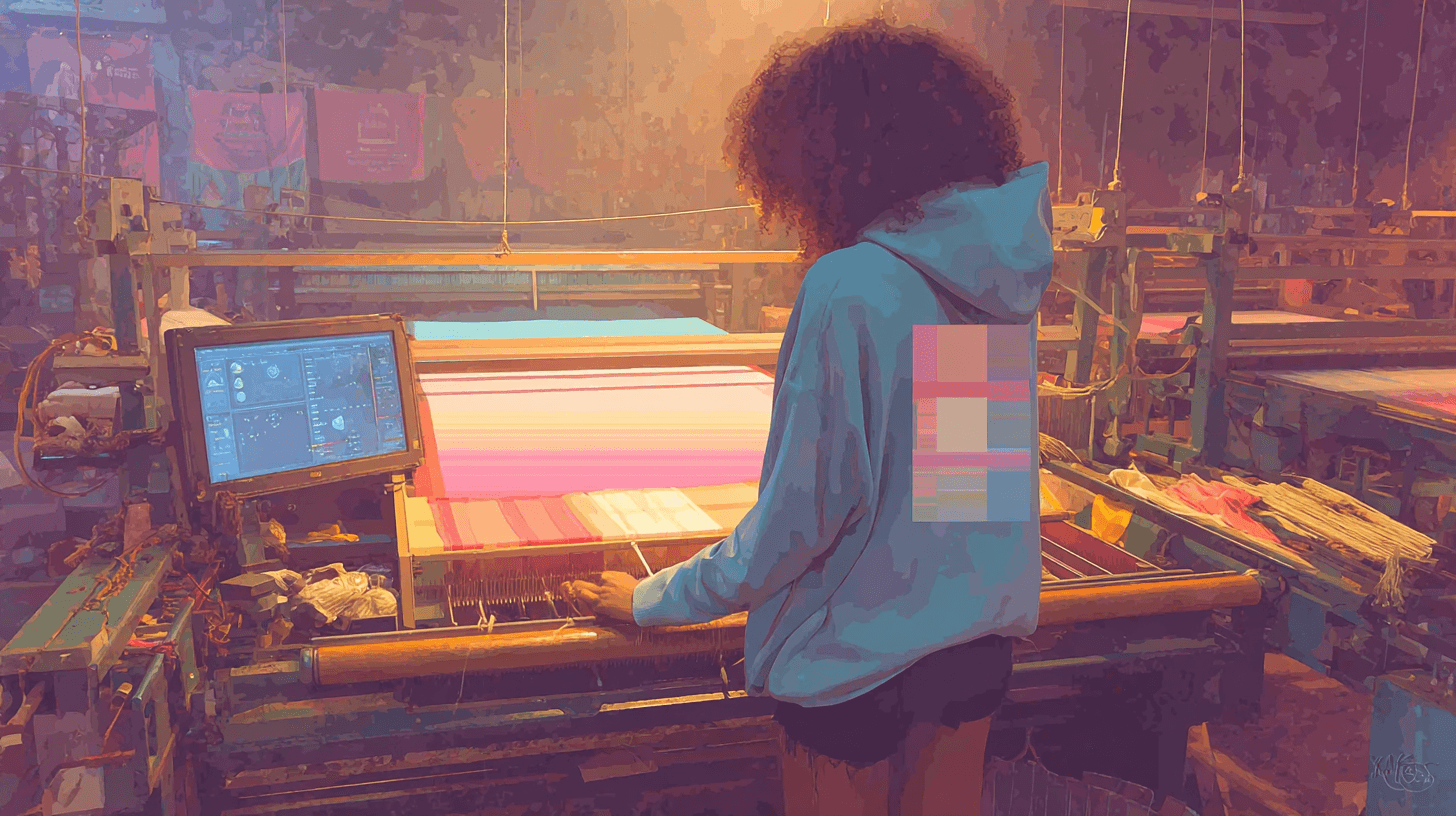
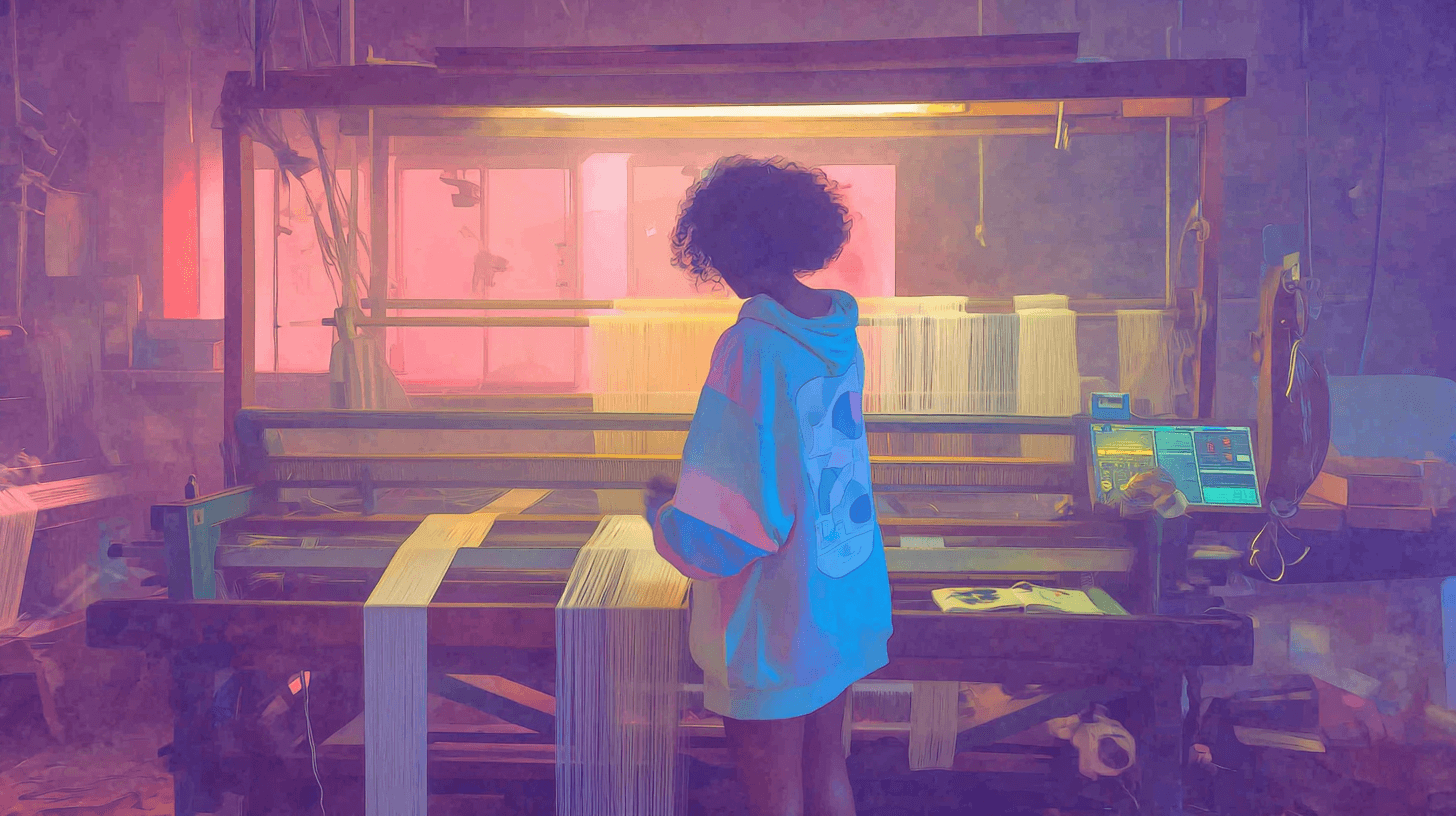
The designer is working locally with tools that are strong enough to matter. Open source hardware, small-scale CNC, looms, cutters, plus local compute for simulation or generation. They’re not depending on some distant system to validate or host their work. They can move quickly between idea and material. That loop—design, test, adjust, remake—stays tight and personal. And because the substrate is open, they can pull from anywhere, remix anything, and others can do the same with their work.
Now the confidential layer sits completely outside of that. Sales, conversations with buyers, sizing details, preferences—those never enter the commons at all. They’re handled through systems that keep that data bounded to the interaction itself. If a buyer proves they own or received a piece, that proof doesn’t expose their identity or history beyond what’s needed for that moment. It’s more like a capability than a record.
So you end up with two worlds running in parallel without overlap. The commons is rich, evolving, visible. The interaction layer is precise, minimal, and only accessible to the parties involved. There’s no need to bridge them because they’re serving different roles.
For an indie designer, that changes the role completely. Instead of being “the author of a collection,” they can operate more like an orchestrator of processes. They set up systems—pattern generators, constraints, material rules, maybe small agent loops—and let outputs emerge. Some of those outputs they might sign directly. Others they might leave unsigned, or sign through a different identity, or not attach identity at all.
So you get multiple layers of presence: direct authorship, where the designer clearly signs and stands behind a piece, indirect authorship, where they guide a system but don’t attach their name explicitly, ambient output, where things are produced within a space they created but are not claimed.
All of these can coexist because the commons layer doesn’t require attribution to function. Agent orchestration fits into this cleanly. The designer can run multiple agents—some generating pattern variations, others testing constraints, others combining existing CC0 fragments. These agents don’t need to be hidden or proprietary. They can operate openly, producing streams of designs that anyone can pick up.
Not every output needs to be turned into a garment. Many can remain as raw substrate, feeding the broader graph. Multiple profiles or brands also make sense here, but they behave differently from traditional branding. They’re not about segmenting a market under a corporate structure. They’re more like different entry points into the same underlying practice.
One identity might focus on highly material, locally produced pieces. Another might explore purely digital or generative patterns. Another might operate as a collaborative node, blending inputs from others. All of these can share underlying tools and processes without needing to be unified under a single label. They’re just different projections of the same designer moving through the space.
Because provenance is tied to signatures rather than licenses, the designer can decide when and how to attach themselves. A piece can exist first, and attribution can come later—or never. That flexibility allows experimentation without constant commitment to identity.
It also allows for collective emergence. Multiple designers and agents can contribute to a pattern lineage without needing to resolve who “owns” it. The lineage itself becomes the object of interest, and different nodes in it can gain attention based on how they’re used or instantiated.
For the indie designer, this removes a lot of pressure to produce coherent, branded outputs. They don’t need to maintain a consistent aesthetic across everything. They can explore multiple directions simultaneously, let some threads fade, push others further, and only anchor what feels worth carrying forward.